Days Of Elijah: "Days Of Elijah
These are the days of Elijah,
Declaring the word of the Lord:
And these are the days of Your servant Moses,
Righteousness being restored.
And though these are days of great trial,
Of famine and darkness and sword,
Still, we are the voice in the desert crying
'Prepare ye the way of the Lord!'
Behold He comes riding on the clouds,
Shining like the sun at the trumpet call;
Lift your voice, it's the year of jubilee,
And out of Zion's hill salvation comes.
These are the days of Ezekiel,
The dry bones becoming as flesh;
And these are the days of Your servant David,
Rebuilding a temple of praise.
These are the days of the harvest,
The fields are as white in Your world,
And we are the labourers in Your vineyard,
Declaring the word of the Lord!
There's no God like Jehovah.
There's no God like Jehovah!
Copyright © 1997 Daybreak Music Ltd."
Monday, April 7, 2008

Sunday, April 6, 2008
People and Places
And so to Sunday and something of a dilemma. Is church about people or places?
Here in Jerusalem that's not just a theoretical question. It's a buring question as Holy Places take on such significance.
I was drawn to step out of my tradition and go with places. That's part of the wonderful opportunity this place, Tantur gives!
A Place to Worship through the Night?
A group of us had decided to take the opportunity to go to the church of the Holy Sepulchre towards the end of the evening on Saturday. There they would remain past midnight when the doors would be locked.
This morning at breakfast I heard from Ian, the Orthodox priest from Oxford who is part of our company. He had found it a wonderfully inspiring night vigil, sharing not only in a deeply moving time of prayer but also in a liturgy with which he was very familiar.
He was not alone. And this is the genius of this week!
He was joined by friends, Dan and Phil, one in training for ministry, the other candidating for the Baptist ministry and by the person I am sharing a room with, Matthew, from a free evangelical church in South Wales.
This evening I have just had a conversation with Matthew who reported in equally moving terms from a totally different perspective how wonderful the night had been. For two and a half hours they had been part of a small number alone in the Church of the Holy Sepulchre able to wander freely to the Golgotha and to the cave of the resurrection. It had been deeply inspiring, he commented.
What moved him in particular was the way in which the monks seemed to change and come into their own as the doors were locked. They were no longer keeping watch over the hordes of tourists, little more than janitors. Straightaway they turned to prayer. They were so sincere in that prayer, Matthew commented. Not only that, but they were very welcoming, delighted to be joined by their visitors once they gathered that they were there to pray in silence too.
And then they were joined by ?? a party of Ukrainians for a liturgy which Matthew commented was so strange and alien to him, and yet strangely moving, but which Ian was completely at home in.
What a wonderful mix.
In one way I was sorry to miss it!
A Place to Journey through the Afternoon?
I was also drawn this afternoon to join Kathleen as she led a group along the Via Dolorosa following the Stations of the Cross. Those who accompanied her found it a very moving experience at first in spite of the jostling crowds, and later, as a URC minister, Richard, commented almost because of those jostling crowds. That was as it would surely have been. Hostile crowds. He noticed, however that they were not at all hostile. The shopkeepers when they saw what they were doing didn't interrupt them or hastle them at all. At each station they read the words from the leaflet, words of scripture and words of commentary, one person had been allocated each station and shared a short reflection. Then they prayed the prayer of St Richard (I should really have been there!) and then sang Jesus remember me. As they sang those words on one occasion a Muslim shopkeeper asked them, quite sincerely to ask Jesus to remember him as well.
What a wonderful experience that would have been. But I didn’t' share it.
A Place to Worship Seven Miles from Jerusalem?
One group were going to a Benedictine Monastery at Abu Ghosh, the location of Emmaus. Following in my father's footsteps and having now preached on the Road to Emmaus on Easter Sunday Evening (first my father and then me) for 68 years that was a big draw.
It was an opportunity to worship outside of my tradition. And that is what the Tantur experience is all about.
But then I thought again.
Today I chose people, not places.
And not just any people!
Joining 'My' People
I chose my people, the people I am familiar with, the people I feel at home with. In the free church tradition. As close to where I am at home. Not a Congregational Church, but a Baptist Church.
So it was that I went with a small group, including Rosemary who works with Graham Sparkes for the Baptist Union in their ecumenical and social justice work. Rosemay is also married to the principal of the Baptist College in Luther King House in Manchester and so knows Graham Adams well, to the East Jerusalem Baptist Church.
We took the 124 Arab bus from outside the Tantur gates down into Jerusalem and the Damascus Gate. We made our way past St George's cathedral and found the Baptist church to discover we were 45 minutes early. We enjoyed coffee in a little café opposite.
There the service was led in a wonderfully gentle way by Alex Awad, who had been our speaker earlier in the week. The music group led us in some lovely worship songs, and some lovely hymns.
A couple I want to sing again! If anyone reads this in time to make some changes on Sunday that would be great!
These are the days of Elijah had a haunting melody and was beautiful. 'O God of every nation' not only had words that spoke very much into our journey of Reconciliation. Not only that but we sang it to a beautiful Welsh tune Llangoffan.
The music group played in a way that was just right for me and very much as Hy-Spirit leads us back home at Highbury.
All the international visitors were welcomed and gave greetings. One group had come from a United Methodist Church in Birmingham Alabama to re-decorate the church. They had done a marvelous job. A couple of the Christian Peace maker team were there, others of whom we had met in Hebron. We gave our greetings. We had been asked if we wanted to to share a verse. A wonderful old Welsh Chapel custom that I had experienced when I was little and when I was a student at Penrallt English Baptist Church. The verse that came to my mind was the verse that has meant so much to Ivy Saddler and has meant a lot to me as well.
1 Peter 5:7. Cast all your anxiety on him and he will care for you.
I couldn't help but notice that Alex Awad quoted the verse differently. Cast all your anxieties on him, and he will care for you. As had occurred to me when I had read the CWM daily devotion and the same change had been made, it is not only that we can place our state of anxiety on to Christ, but we can also put into his hands, one by one, as it were, the anxieties that go to make up that state of anxiety. And Alex, as he had already shared with us, and shared with us again after the service, and his people have many, many anxieties.
Prayers were moving too. We were asked to play for people and for places, not least Bethany. Almost surrounded now by new Settlements and by the Settlers Road it is often not possible for Palestinians living there to access the hospitals facilities in Jerusalem. So we were asked to pray for a new birthing centre that money is being raised for and for midwives to staff it so that those who are pregnant can access hospital facilities.
After the prayers we came to what for me was the most moving part of the service. For the third time in our week here I was moved to tears. During the sharing of communion we sang Isaac Watts' hymn When I survey the wondrous cross, finishing with a triumphant extra verse The wonderful cross.
It was mainly the words, and the act of sharing communion in that Gathered church there in Jerusalem in the city where Jesus shared the last supper, but in a small way it was also because this was part of me. This was one of 'my' people. Isaac Watts from a dissenting church, a Congregational church, was one of those with whom I had grown up. This was my. This was where I belong. And this is the One to whom I belong.
Very moving. The tears came down my cheeks.
The preacher reflected on the healing of the boy with an evil spirit and focused on the way all things are possible for God. And then the service came to an end. A full 2 and a bit hours after it had started.
Refreshments in the garden gave an opportunity to chat with Helen Awad and with Alex again. Rosemary made contacts as from the Baptist Union.
And then came the bonus.
People in a Special Place
Because of the 'people' we had worshipped with, we were able to visit a very special 'place' after all.
The Garden Tomb.
Others had been rather dismissive of this Protestant 'place'. We had hoped to visit it on the way to church but it had been closed on Sundays.
The people who run this British run 'Holy Place' had been with us in church. Reg and ? Elaine ? invited us to look round.
In their company a group of four of us were treated to a tour of the Garden Tomb site. Discovered and acquired in the late Nineteenth Century by someone called Gordon, it was quite different from the church of the Holy Sepulchre.
It was on a site that 'could have been' the site of the crucifixion and the resurrection. The hill was on top of an old quarry that had the appearance of a skull, not only because of the arrangement of caves in the rough-hewn quarry face, but also because of the white limestone. We were told it was a quarry that Herod would have used to create his new Temple.
Through the beautifully kept quiet, empty gardens, free of 'tourists' we made our way down to the tomb itself. A Roman period tomb, that clearly had been owned by a wealthy person, it had the 'feel' of the 'kind of' tomb that Jesus was buried in. Over it a Byzantine church, long since gone, had been built and some of its remains could be seen.
Inside the tomb, lit by an opening was a place where the body would have been laid to rest.
As our guides who lived on the site explained, it wasn't so much the importance of the place, after all the Tomb had had a use only for three days! After that it was no longer of significance! Rather its importance was as a visual aid. It gave the feel of what the place would have been like.
A moving time, not least because of the people who showed us round.
At this point our group split again and I found myself joining Rosemary and making our way through the Damascus Gate and into the Arab market where we found a lovely restaurant and enjoyed a feast at a reasonable price too!
Then it was back to the bus station and on to the 124 Arab bus for Bethlehem for the princely sum of 4 Shekels, less than 50p.
Back to Tantur and on to the next adventure of the day.
Once again, it was people not places that drew us back through the checkpoint and into Bethlehem.
People in Prayer
This time on the other side of the wall Rosemary and I passed through the taxi drivers, my first taxi-driver greeting me with a smile once more, and there we waited for the taxi that would pick us up to take us to another service where we joined in worship for the second time in the day.
We returned to John 6 and the account of the storm on the lake and the presence of Jesus with his people. A theme that I seem to be coming back to!
During the prayers my mind turned to home, to Felicity and the family and to Jan and Angela and Natalie and Stephanie. It was somehow good to share in prayers for Jan and the family there in Bethlehem. I felt he would have been touched. It is strange how places can sometimes feel significant.
At the end of the evening Rosemary and I caught another taxi back to the checkpoint and might have been in the company of one our speakers.
People united in Christ and yet divided by a wall
Within his family he had a wonderful mix of traditions, but told us that all that counts, is that we are one in Christ. Jew and Christians as friends.
The route back to the Checkpoint took us past Rachel's tomb. It's exactly over there he said, fifteen feet away. But ten feet from the car was a twenty metre high wall. There was scarcely the width of a car between the wall and the houses next to it. And then he showed us one house surrounded on three sides by the wall, ten feet away.
With a heavy heart we returned to the check point.
We walked through the caged walkway a good 100 metres and more to the first turnstile gateway. A mother and three children were waiting there. We waited five minutes. When there was no activity someone coming through the other way called through the bars of the fence that we must go back and go round to the vehicle entry.
We followed the little family, the children carrying heavy bags and another two who we met coming up the path as we went down it. There was no indication it was closed. No instructions what to do or where to go.
We walked through a deserted car park, about a quarter of a mile up another road to the vehicle exit.
There we waited in turn.
Each of the men had to wait and lift up their shirts and their trouser legs before going through one at a time. The mother and little child went first, the other two next.
Then it was our turn.
There was another wait by the next turnstile. One of the bags was dropped and lots of potatoes rolled over the floor.
And then another queue, before we were ushered through another turnstile and through to the other side of the wall.
It was twenty minutes since our taxi had dropped us and quite some walk back to Tantur on the main road and round to the main entrance at this time of the evening.
A good conversation followed, and a late packed lunch that served as the usual Sunday evening meal.
Fun conversations highlighted what others had done, not least one group who had been swimming, or rather bobbing, in the Dead Sea. Maybe another time!!
Here in Jerusalem that's not just a theoretical question. It's a buring question as Holy Places take on such significance.
I was drawn to step out of my tradition and go with places. That's part of the wonderful opportunity this place, Tantur gives!
A Place to Worship through the Night?
A group of us had decided to take the opportunity to go to the church of the Holy Sepulchre towards the end of the evening on Saturday. There they would remain past midnight when the doors would be locked.
This morning at breakfast I heard from Ian, the Orthodox priest from Oxford who is part of our company. He had found it a wonderfully inspiring night vigil, sharing not only in a deeply moving time of prayer but also in a liturgy with which he was very familiar.
He was not alone. And this is the genius of this week!
He was joined by friends, Dan and Phil, one in training for ministry, the other candidating for the Baptist ministry and by the person I am sharing a room with, Matthew, from a free evangelical church in South Wales.
This evening I have just had a conversation with Matthew who reported in equally moving terms from a totally different perspective how wonderful the night had been. For two and a half hours they had been part of a small number alone in the Church of the Holy Sepulchre able to wander freely to the Golgotha and to the cave of the resurrection. It had been deeply inspiring, he commented.
What moved him in particular was the way in which the monks seemed to change and come into their own as the doors were locked. They were no longer keeping watch over the hordes of tourists, little more than janitors. Straightaway they turned to prayer. They were so sincere in that prayer, Matthew commented. Not only that, but they were very welcoming, delighted to be joined by their visitors once they gathered that they were there to pray in silence too.
And then they were joined by ?? a party of Ukrainians for a liturgy which Matthew commented was so strange and alien to him, and yet strangely moving, but which Ian was completely at home in.
What a wonderful mix.
In one way I was sorry to miss it!
A Place to Journey through the Afternoon?
I was also drawn this afternoon to join Kathleen as she led a group along the Via Dolorosa following the Stations of the Cross. Those who accompanied her found it a very moving experience at first in spite of the jostling crowds, and later, as a URC minister, Richard, commented almost because of those jostling crowds. That was as it would surely have been. Hostile crowds. He noticed, however that they were not at all hostile. The shopkeepers when they saw what they were doing didn't interrupt them or hastle them at all. At each station they read the words from the leaflet, words of scripture and words of commentary, one person had been allocated each station and shared a short reflection. Then they prayed the prayer of St Richard (I should really have been there!) and then sang Jesus remember me. As they sang those words on one occasion a Muslim shopkeeper asked them, quite sincerely to ask Jesus to remember him as well.
What a wonderful experience that would have been. But I didn’t' share it.
A Place to Worship Seven Miles from Jerusalem?
One group were going to a Benedictine Monastery at Abu Ghosh, the location of Emmaus. Following in my father's footsteps and having now preached on the Road to Emmaus on Easter Sunday Evening (first my father and then me) for 68 years that was a big draw.
It was an opportunity to worship outside of my tradition. And that is what the Tantur experience is all about.
But then I thought again.
Today I chose people, not places.
And not just any people!
Joining 'My' People
I chose my people, the people I am familiar with, the people I feel at home with. In the free church tradition. As close to where I am at home. Not a Congregational Church, but a Baptist Church.
So it was that I went with a small group, including Rosemary who works with Graham Sparkes for the Baptist Union in their ecumenical and social justice work. Rosemay is also married to the principal of the Baptist College in Luther King House in Manchester and so knows Graham Adams well, to the East Jerusalem Baptist Church.
We took the 124 Arab bus from outside the Tantur gates down into Jerusalem and the Damascus Gate. We made our way past St George's cathedral and found the Baptist church to discover we were 45 minutes early. We enjoyed coffee in a little café opposite.
There the service was led in a wonderfully gentle way by Alex Awad, who had been our speaker earlier in the week. The music group led us in some lovely worship songs, and some lovely hymns.
A couple I want to sing again! If anyone reads this in time to make some changes on Sunday that would be great!
These are the days of Elijah had a haunting melody and was beautiful. 'O God of every nation' not only had words that spoke very much into our journey of Reconciliation. Not only that but we sang it to a beautiful Welsh tune Llangoffan.
The music group played in a way that was just right for me and very much as Hy-Spirit leads us back home at Highbury.
All the international visitors were welcomed and gave greetings. One group had come from a United Methodist Church in Birmingham Alabama to re-decorate the church. They had done a marvelous job. A couple of the Christian Peace maker team were there, others of whom we had met in Hebron. We gave our greetings. We had been asked if we wanted to to share a verse. A wonderful old Welsh Chapel custom that I had experienced when I was little and when I was a student at Penrallt English Baptist Church. The verse that came to my mind was the verse that has meant so much to Ivy Saddler and has meant a lot to me as well.
1 Peter 5:7. Cast all your anxiety on him and he will care for you.
I couldn't help but notice that Alex Awad quoted the verse differently. Cast all your anxieties on him, and he will care for you. As had occurred to me when I had read the CWM daily devotion and the same change had been made, it is not only that we can place our state of anxiety on to Christ, but we can also put into his hands, one by one, as it were, the anxieties that go to make up that state of anxiety. And Alex, as he had already shared with us, and shared with us again after the service, and his people have many, many anxieties.
Prayers were moving too. We were asked to play for people and for places, not least Bethany. Almost surrounded now by new Settlements and by the Settlers Road it is often not possible for Palestinians living there to access the hospitals facilities in Jerusalem. So we were asked to pray for a new birthing centre that money is being raised for and for midwives to staff it so that those who are pregnant can access hospital facilities.
After the prayers we came to what for me was the most moving part of the service. For the third time in our week here I was moved to tears. During the sharing of communion we sang Isaac Watts' hymn When I survey the wondrous cross, finishing with a triumphant extra verse The wonderful cross.
It was mainly the words, and the act of sharing communion in that Gathered church there in Jerusalem in the city where Jesus shared the last supper, but in a small way it was also because this was part of me. This was one of 'my' people. Isaac Watts from a dissenting church, a Congregational church, was one of those with whom I had grown up. This was my. This was where I belong. And this is the One to whom I belong.
Very moving. The tears came down my cheeks.
The preacher reflected on the healing of the boy with an evil spirit and focused on the way all things are possible for God. And then the service came to an end. A full 2 and a bit hours after it had started.
Refreshments in the garden gave an opportunity to chat with Helen Awad and with Alex again. Rosemary made contacts as from the Baptist Union.
And then came the bonus.
People in a Special Place
Because of the 'people' we had worshipped with, we were able to visit a very special 'place' after all.
The Garden Tomb.
Others had been rather dismissive of this Protestant 'place'. We had hoped to visit it on the way to church but it had been closed on Sundays.
The people who run this British run 'Holy Place' had been with us in church. Reg and ? Elaine ? invited us to look round.
In their company a group of four of us were treated to a tour of the Garden Tomb site. Discovered and acquired in the late Nineteenth Century by someone called Gordon, it was quite different from the church of the Holy Sepulchre.
It was on a site that 'could have been' the site of the crucifixion and the resurrection. The hill was on top of an old quarry that had the appearance of a skull, not only because of the arrangement of caves in the rough-hewn quarry face, but also because of the white limestone. We were told it was a quarry that Herod would have used to create his new Temple.
Through the beautifully kept quiet, empty gardens, free of 'tourists' we made our way down to the tomb itself. A Roman period tomb, that clearly had been owned by a wealthy person, it had the 'feel' of the 'kind of' tomb that Jesus was buried in. Over it a Byzantine church, long since gone, had been built and some of its remains could be seen.
Inside the tomb, lit by an opening was a place where the body would have been laid to rest.
As our guides who lived on the site explained, it wasn't so much the importance of the place, after all the Tomb had had a use only for three days! After that it was no longer of significance! Rather its importance was as a visual aid. It gave the feel of what the place would have been like.
A moving time, not least because of the people who showed us round.
At this point our group split again and I found myself joining Rosemary and making our way through the Damascus Gate and into the Arab market where we found a lovely restaurant and enjoyed a feast at a reasonable price too!
Then it was back to the bus station and on to the 124 Arab bus for Bethlehem for the princely sum of 4 Shekels, less than 50p.
Back to Tantur and on to the next adventure of the day.
Once again, it was people not places that drew us back through the checkpoint and into Bethlehem.
People in Prayer
This time on the other side of the wall Rosemary and I passed through the taxi drivers, my first taxi-driver greeting me with a smile once more, and there we waited for the taxi that would pick us up to take us to another service where we joined in worship for the second time in the day.
We returned to John 6 and the account of the storm on the lake and the presence of Jesus with his people. A theme that I seem to be coming back to!
During the prayers my mind turned to home, to Felicity and the family and to Jan and Angela and Natalie and Stephanie. It was somehow good to share in prayers for Jan and the family there in Bethlehem. I felt he would have been touched. It is strange how places can sometimes feel significant.
At the end of the evening Rosemary and I caught another taxi back to the checkpoint and might have been in the company of one our speakers.
People united in Christ and yet divided by a wall
Within his family he had a wonderful mix of traditions, but told us that all that counts, is that we are one in Christ. Jew and Christians as friends.
The route back to the Checkpoint took us past Rachel's tomb. It's exactly over there he said, fifteen feet away. But ten feet from the car was a twenty metre high wall. There was scarcely the width of a car between the wall and the houses next to it. And then he showed us one house surrounded on three sides by the wall, ten feet away.
With a heavy heart we returned to the check point.
We walked through the caged walkway a good 100 metres and more to the first turnstile gateway. A mother and three children were waiting there. We waited five minutes. When there was no activity someone coming through the other way called through the bars of the fence that we must go back and go round to the vehicle entry.
We followed the little family, the children carrying heavy bags and another two who we met coming up the path as we went down it. There was no indication it was closed. No instructions what to do or where to go.
We walked through a deserted car park, about a quarter of a mile up another road to the vehicle exit.
There we waited in turn.
Each of the men had to wait and lift up their shirts and their trouser legs before going through one at a time. The mother and little child went first, the other two next.
Then it was our turn.
There was another wait by the next turnstile. One of the bags was dropped and lots of potatoes rolled over the floor.
And then another queue, before we were ushered through another turnstile and through to the other side of the wall.
It was twenty minutes since our taxi had dropped us and quite some walk back to Tantur on the main road and round to the main entrance at this time of the evening.
A good conversation followed, and a late packed lunch that served as the usual Sunday evening meal.
Fun conversations highlighted what others had done, not least one group who had been swimming, or rather bobbing, in the Dead Sea. Maybe another time!!
Saturday, April 5, 2008
It is I. Do not be afraid.
Much has happened once again today.
But before I describe it ... aren't the pictures great!! Thanks to Felicity for her creative work! I am thinking of you all and you are very much in my thoughts and prayers. Hope you get some ideas for more pictures and links today!
I have also come up with some thoughts for prayer - hope they can be passed on too!
I am thinking of you all for tomorrow's service, please pass my greetings on to everyone and especially to Chris Lammiman and to Marion Hartwell as they take our services.
How much to write?
Michael McGarry in his introduction back at the beginning of the week told the salutary tale of three people who had visited the Holy Land.
One stayed for a week and wrote a book on his return.
One stayed a fortnight and wrote an article.
One stayed a month and could write nothing.
As we move from one speaker to the next, from one situation to another, we see things from yet another perspective.
The complexities of the Holy Land are immense. The more you learn the more you realize how little you know and understand.
Morning Prayers
The day began at 6-30 with a Catholic mass and a reading from John 6 and the disciples caught in a storm on the sea. Jesus joins them over the water and says, "It is I. Do not be afraid.
Evening prayers came back to the same story, half remembered for a reason that will become apparent.
It was a moving passage to begin and end the day with. In the middle of the storm, a presence, the presence of Christ who says, It is I. Do not be afraid. Simply a presence. A presence that takes away fear.
Well, I'll eat my hat ... on the other side of the wall in Bethlehem!
Morning prayers over and breakfast finished, I packed my bag, complete with my new sun hat and set off for the check point. On the other side who should I meet but a bunch of taxi drivers. One seemed to recognize me. I mentioned my hat. I soon had a crowd of taxi drivers around me, one of whom opened his boot and presented me with a hat.
My trust in human nature was restored. As was my hat!
I didn't have to bargain for a taxi today, however, as I was to going to be picked up by my friend's van.
Owner of a wonderful souvenir shop, I hoped agains hope that his van would turn up.
In due course the van turned up. We had to wait for another party who turned out to be from Papua New Guinea. One of their number was from the Uniting Church of Papua New Guinea, one of our mission partners through the Council for World Mission. He lived in Port Moresby … but didn't remember Maureen Williams who spent a couple of years out there with CWM more years ago than my new found friend could remember!
The bus deposited me at the shop just as a contingent of my fellow travelers on our Journey of Reconciliation at Tantur arrived, hot and sweaty, on foot. They had set off before me and I had arrived first. I felt a bit sheepish getting out of a mini bus … but my friend, the shop owner, was only too pressing that the others should come and sample the delights of his shop and get a good discount too!
I took my seat with my friend's father by the door of the shop and was soon enjoying a Palestinian Mint Tea and talking with the 86 year old. His father and grandfather before him had served as priests in the Church of the Nativity.
Fluent in seven languages, English, Arabic, Hebrew, French, Spanish, Greek and one other, it made you realize what an international and world city Bethlehem was.
Only two of his seven sons were still in Bethlehem with their families and each owned a shop. The other five were in the States, one a neuro-surgeon. One branch of the family had emigrated as long ago as 1917, arriving in the States at the Statue of Liberty that year.
There was a sadness about him as he felt the sadness of losing his wife, but also as he felt the sadness of the plight of his people in Bethlehem.
By now many of our walking friends were on the way back and they all came into the shop, to Johnny's delight and to their pleasure with a good discount available too!
The morning came to an end as those who wanted it were offered a lift back to the check point.
I followed on in another car and negotiated the check point on my own. The indignity of the residents of Bethlehem was all too plain as I waited in line behind a queue of Palestinians.
Through the checkpoint I was back for lunch at 12-30 and in time to get on the bus at 1-15 for Hebron.
To Hebron - a Peace-making Presence
An ancient city that claims to be the location for the tomb of Abraham, Isaac, Jacob and Rebekkah. It is a big city on the West Bank, accessible only on a 'settler road'. Those are the roads closed to Palestinians and open only to cars with an Israeli number plate, officially licensed minibuses and coaches like ours.
Our visit started with a troubled charity facing a very uncertain future.
Where are the rights and wrongs? Their appeal to us was to publicise their plight. Do we know enough to do so? Who can investigate? Does this kind of thing make it to our news? If not, why not?
We met members of the Christain peacemaking team, one of whom knew a predecessor of mine long ago. A Quaker, he told of us the World Council of Churches' Ecumenical Accopaniment Programme. That is another initiative that simply sends Christians to be alongside people on the West Bank and in other trouble spots. Being simply 'a presence' there often made all the difference.
In Hebron, their work is simply to be a presence in the old part of the city.
In the heart of the ancient city centre is a Jewish settler presence of 400 people. They are guarded by 2000 Israeli soldiers, with a massive number of road blocks. The settlers often harass children particularly of Palestinian families as they go to school. The Christian Peace Makers simply go along to the road blocks and accompany the children to school. That way they are a calming presence in the town.
They were invited into Hebron back in the early 1990's when an Israeli soldier attacked and machine gunned a group of Palestinians before himself being shot by other Israeli soldiers. The Hebron authorities invited the Christian Peace Maker team to come in and simply be a presence.
A great number of people have told us how wonderful there work has been in de-fusing and calming a very troubled situation.
It was troubling to walk through the city as we made our way past roadblocks and soldiers to Abraham's tomb, through the souk and back.
We returned to our coach and left that troubled city.
By now we had missed our evening prayers and were late for dinner.
No matter, as we drove along the settler road, past Jewish settlements deep into the Palestinian territory three of our number led us in our evening prayers.
Evening Prayers ... on a bus
One of our number shared the bible reading. He did it from memory, reminding us of the story. It was the story of the disciples, scared out of their minds in a storm on the sea. And Jesus came to them over the troubled water and simply said, 'It is I. Do not be afraid'
How remarkably moving those words were now. Simply the presence of Christ took away their fear.
It had been simply the presence of those Christian peace Makers that had made all the difference. Never mind all the holy places we have visited, here we encountered the presence of Christ.
We sang the Taize chant, Jesus remember me. But those weren't the words we used … Jesus remember them, we sang, as you come into your kingdom. Jesus, remember them … That was our prayer.
Then Phil, the son of the Baptist minister of the church in Gloucester where Ernest Bratt and his wife are members.
Phil's prayers were intensely moving. The reading had simply been the lectionary reading for the day … and yet it had taken on such meaning. He had prepared and written his prayers long before the experiences of the afternoon in Hebron. And yet in the most moving of ways they were so appropriate.
He invited us to go back to creation and sense the spirit of God moving over the chaos of the waters. He invited us to share a response. I cannot quite remember it. In the confusion, God, make good.
It was a curious response … and yet most moving.
The appeal to the God of creation was so moving. The limestone landscape with its brilliant white has haunted me. I sometimes think the God who is greater than all creation in its geological age, smiles at the inhumanity of humanity in its brief period on this globe. Over the confusion the spirit;s presence was felt – in that Confusion, God, make good!
We went on to think of the confusion we had just witnessed, the chaos on the streets of that city, the fear. And we prayed in that confusion, God, make good.
And then we thought of our own confusions, all our inadequacies. God, make good.
How powerful the prayer!
Words weren't necessary for the remainder of the journey, though I did recall my story of the trilobites in other rocks of fond memory to my weary companion on the coach. The assembly came to mind that I had taken. How one tiny trilobite had left its mark 400 million years ago. Maybe the little gesture for peace leaves a greater mark than we might imagine.
Simply the presence!
What can we do?
A lovely supper and on to our next speaker. An hour with one of the leaders of the Jerusalem Inter-Church Council gave us the opportunity to hear how church leaders are coming together to engage with the authorities. Coming together with each other, but also getting together with leaders of other faith communities as well.
He dwelled on the diminishing numbers of Christians and spoke again of the importance of simply the presence of those Christian people.
He spoke of the Ecumenical Accompaniment programme we had already learned of that afternoon and of the immensely important work it is doing.
How important that presence is. Continually this afternoon and evening we have been coming back to that.
The council had accomplished four things – they had open a line of communication between all the Christian church leaders in the event of trouble flaring up in Israel Palestine and especially in Jerusalem. They had initiated a mechanism to monitor harmful things that are said from one church or faith community to another, things that will damage relations. They had initiated a new education programme to work for peace. And they had reflected on a long term solution for the status of the churches in Jerusalem.
Small things, and yet with significance.
He spoke of the call they had given to churches throughout the world, first to pray with churches living under occupation. He suggested finding and using a prayer written jointly by the leaders of the Jerusalem churches for the peace of Jerusalem and for the peace of Israel and Palestine. It can be found on the World Council of Churches website.
Secondly, there was a need to educate people about the situation in Israel/Palestine.
Third, there was a need to lobby political leaders to make a difference. In particular, he recalled the recent Anapolis Agreement when Israel agreed to cease any further settlements, and yet since then settlements continued to be built – and we can see them going up all around us here at Tantur! Why aren't the leaders of the nations doing anything about it, he asked.
As Israel celebrates the 60tn Anniversary of the creation of the state of Israel, the Palestinians will be commemorating the 60th Anniversary of what they call the catastrophe when 700,000 were moved, often forcibly, from their homes into the very kind of refugee camps that I had visited only yesterday afternoon.
For some a celebration. For others a commemoration.
For all, at the moment, a stormy time with apparently no end in sight.
And for us as Christians.
A Date for the Diary
He invited us to note the dates 4th to 10th June. That's when the churches of Israel/Palestine invite churches all over the world to think of them especially.
I don't have my diary with me … but hopefully that's a moment when I shall be able to have a special evening to share my experiences and reflect on all that I have encountered.
An Invitation to Prayer
Maybe, now the end of the day really has arrive, we need to come back to those simple words.
It is I.
Do not be afraid.
Simply a presence. Maybe we can do no more.
Maybe in being such a presence we are doing all.
I had hoped to list some prayer requests for tomorrow. There is so much to pray for I cannot get my mind round making such a list.
More important is to pray that Christ's presence may be felt. In the middle of the storm, wherever that storm may be and whatever form it may take may Christ approach through the stormy waters and may his voice be heard.
It is I.
Do not be afraid.
But before I describe it ... aren't the pictures great!! Thanks to Felicity for her creative work! I am thinking of you all and you are very much in my thoughts and prayers. Hope you get some ideas for more pictures and links today!
I have also come up with some thoughts for prayer - hope they can be passed on too!
I am thinking of you all for tomorrow's service, please pass my greetings on to everyone and especially to Chris Lammiman and to Marion Hartwell as they take our services.
How much to write?
Michael McGarry in his introduction back at the beginning of the week told the salutary tale of three people who had visited the Holy Land.
One stayed for a week and wrote a book on his return.
One stayed a fortnight and wrote an article.
One stayed a month and could write nothing.
As we move from one speaker to the next, from one situation to another, we see things from yet another perspective.
The complexities of the Holy Land are immense. The more you learn the more you realize how little you know and understand.
Morning Prayers
The day began at 6-30 with a Catholic mass and a reading from John 6 and the disciples caught in a storm on the sea. Jesus joins them over the water and says, "It is I. Do not be afraid.
Evening prayers came back to the same story, half remembered for a reason that will become apparent.
It was a moving passage to begin and end the day with. In the middle of the storm, a presence, the presence of Christ who says, It is I. Do not be afraid. Simply a presence. A presence that takes away fear.
Well, I'll eat my hat ... on the other side of the wall in Bethlehem!
Morning prayers over and breakfast finished, I packed my bag, complete with my new sun hat and set off for the check point. On the other side who should I meet but a bunch of taxi drivers. One seemed to recognize me. I mentioned my hat. I soon had a crowd of taxi drivers around me, one of whom opened his boot and presented me with a hat.
My trust in human nature was restored. As was my hat!
I didn't have to bargain for a taxi today, however, as I was to going to be picked up by my friend's van.
Owner of a wonderful souvenir shop, I hoped agains hope that his van would turn up.
In due course the van turned up. We had to wait for another party who turned out to be from Papua New Guinea. One of their number was from the Uniting Church of Papua New Guinea, one of our mission partners through the Council for World Mission. He lived in Port Moresby … but didn't remember Maureen Williams who spent a couple of years out there with CWM more years ago than my new found friend could remember!
The bus deposited me at the shop just as a contingent of my fellow travelers on our Journey of Reconciliation at Tantur arrived, hot and sweaty, on foot. They had set off before me and I had arrived first. I felt a bit sheepish getting out of a mini bus … but my friend, the shop owner, was only too pressing that the others should come and sample the delights of his shop and get a good discount too!
I took my seat with my friend's father by the door of the shop and was soon enjoying a Palestinian Mint Tea and talking with the 86 year old. His father and grandfather before him had served as priests in the Church of the Nativity.
Fluent in seven languages, English, Arabic, Hebrew, French, Spanish, Greek and one other, it made you realize what an international and world city Bethlehem was.
Only two of his seven sons were still in Bethlehem with their families and each owned a shop. The other five were in the States, one a neuro-surgeon. One branch of the family had emigrated as long ago as 1917, arriving in the States at the Statue of Liberty that year.
There was a sadness about him as he felt the sadness of losing his wife, but also as he felt the sadness of the plight of his people in Bethlehem.
By now many of our walking friends were on the way back and they all came into the shop, to Johnny's delight and to their pleasure with a good discount available too!
The morning came to an end as those who wanted it were offered a lift back to the check point.
I followed on in another car and negotiated the check point on my own. The indignity of the residents of Bethlehem was all too plain as I waited in line behind a queue of Palestinians.
Through the checkpoint I was back for lunch at 12-30 and in time to get on the bus at 1-15 for Hebron.
To Hebron - a Peace-making Presence
An ancient city that claims to be the location for the tomb of Abraham, Isaac, Jacob and Rebekkah. It is a big city on the West Bank, accessible only on a 'settler road'. Those are the roads closed to Palestinians and open only to cars with an Israeli number plate, officially licensed minibuses and coaches like ours.
Our visit started with a troubled charity facing a very uncertain future.
Where are the rights and wrongs? Their appeal to us was to publicise their plight. Do we know enough to do so? Who can investigate? Does this kind of thing make it to our news? If not, why not?
We met members of the Christain peacemaking team, one of whom knew a predecessor of mine long ago. A Quaker, he told of us the World Council of Churches' Ecumenical Accopaniment Programme. That is another initiative that simply sends Christians to be alongside people on the West Bank and in other trouble spots. Being simply 'a presence' there often made all the difference.
In Hebron, their work is simply to be a presence in the old part of the city.
In the heart of the ancient city centre is a Jewish settler presence of 400 people. They are guarded by 2000 Israeli soldiers, with a massive number of road blocks. The settlers often harass children particularly of Palestinian families as they go to school. The Christian Peace Makers simply go along to the road blocks and accompany the children to school. That way they are a calming presence in the town.
They were invited into Hebron back in the early 1990's when an Israeli soldier attacked and machine gunned a group of Palestinians before himself being shot by other Israeli soldiers. The Hebron authorities invited the Christian Peace Maker team to come in and simply be a presence.
A great number of people have told us how wonderful there work has been in de-fusing and calming a very troubled situation.
It was troubling to walk through the city as we made our way past roadblocks and soldiers to Abraham's tomb, through the souk and back.
We returned to our coach and left that troubled city.
By now we had missed our evening prayers and were late for dinner.
No matter, as we drove along the settler road, past Jewish settlements deep into the Palestinian territory three of our number led us in our evening prayers.
Evening Prayers ... on a bus
One of our number shared the bible reading. He did it from memory, reminding us of the story. It was the story of the disciples, scared out of their minds in a storm on the sea. And Jesus came to them over the troubled water and simply said, 'It is I. Do not be afraid'
How remarkably moving those words were now. Simply the presence of Christ took away their fear.
It had been simply the presence of those Christian peace Makers that had made all the difference. Never mind all the holy places we have visited, here we encountered the presence of Christ.
We sang the Taize chant, Jesus remember me. But those weren't the words we used … Jesus remember them, we sang, as you come into your kingdom. Jesus, remember them … That was our prayer.
Then Phil, the son of the Baptist minister of the church in Gloucester where Ernest Bratt and his wife are members.
Phil's prayers were intensely moving. The reading had simply been the lectionary reading for the day … and yet it had taken on such meaning. He had prepared and written his prayers long before the experiences of the afternoon in Hebron. And yet in the most moving of ways they were so appropriate.
He invited us to go back to creation and sense the spirit of God moving over the chaos of the waters. He invited us to share a response. I cannot quite remember it. In the confusion, God, make good.
It was a curious response … and yet most moving.
The appeal to the God of creation was so moving. The limestone landscape with its brilliant white has haunted me. I sometimes think the God who is greater than all creation in its geological age, smiles at the inhumanity of humanity in its brief period on this globe. Over the confusion the spirit;s presence was felt – in that Confusion, God, make good!
We went on to think of the confusion we had just witnessed, the chaos on the streets of that city, the fear. And we prayed in that confusion, God, make good.
And then we thought of our own confusions, all our inadequacies. God, make good.
How powerful the prayer!
Words weren't necessary for the remainder of the journey, though I did recall my story of the trilobites in other rocks of fond memory to my weary companion on the coach. The assembly came to mind that I had taken. How one tiny trilobite had left its mark 400 million years ago. Maybe the little gesture for peace leaves a greater mark than we might imagine.
Simply the presence!
What can we do?
A lovely supper and on to our next speaker. An hour with one of the leaders of the Jerusalem Inter-Church Council gave us the opportunity to hear how church leaders are coming together to engage with the authorities. Coming together with each other, but also getting together with leaders of other faith communities as well.
He dwelled on the diminishing numbers of Christians and spoke again of the importance of simply the presence of those Christian people.
He spoke of the Ecumenical Accompaniment programme we had already learned of that afternoon and of the immensely important work it is doing.
How important that presence is. Continually this afternoon and evening we have been coming back to that.
The council had accomplished four things – they had open a line of communication between all the Christian church leaders in the event of trouble flaring up in Israel Palestine and especially in Jerusalem. They had initiated a mechanism to monitor harmful things that are said from one church or faith community to another, things that will damage relations. They had initiated a new education programme to work for peace. And they had reflected on a long term solution for the status of the churches in Jerusalem.
Small things, and yet with significance.
He spoke of the call they had given to churches throughout the world, first to pray with churches living under occupation. He suggested finding and using a prayer written jointly by the leaders of the Jerusalem churches for the peace of Jerusalem and for the peace of Israel and Palestine. It can be found on the World Council of Churches website.
Secondly, there was a need to educate people about the situation in Israel/Palestine.
Third, there was a need to lobby political leaders to make a difference. In particular, he recalled the recent Anapolis Agreement when Israel agreed to cease any further settlements, and yet since then settlements continued to be built – and we can see them going up all around us here at Tantur! Why aren't the leaders of the nations doing anything about it, he asked.
As Israel celebrates the 60tn Anniversary of the creation of the state of Israel, the Palestinians will be commemorating the 60th Anniversary of what they call the catastrophe when 700,000 were moved, often forcibly, from their homes into the very kind of refugee camps that I had visited only yesterday afternoon.
For some a celebration. For others a commemoration.
For all, at the moment, a stormy time with apparently no end in sight.
And for us as Christians.
A Date for the Diary
He invited us to note the dates 4th to 10th June. That's when the churches of Israel/Palestine invite churches all over the world to think of them especially.
I don't have my diary with me … but hopefully that's a moment when I shall be able to have a special evening to share my experiences and reflect on all that I have encountered.
An Invitation to Prayer
Maybe, now the end of the day really has arrive, we need to come back to those simple words.
It is I.
Do not be afraid.
Simply a presence. Maybe we can do no more.
Maybe in being such a presence we are doing all.
I had hoped to list some prayer requests for tomorrow. There is so much to pray for I cannot get my mind round making such a list.
More important is to pray that Christ's presence may be felt. In the middle of the storm, wherever that storm may be and whatever form it may take may Christ approach through the stormy waters and may his voice be heard.
It is I.
Do not be afraid.
Friday, April 4, 2008
In the footsteps of Jesus
First, the good news. This afternoon I crossed through the checkpoint on my own, itself a forbidding experience, and had a solitary encounter with a host of taxi drivers. Having been advised by my joint host for the afternoon, not to pay more than 15 shekels, I tried my hand at bargaining. After being asked out of one taxi I had already sat in, and after facing off five others convinced that 20 shekels was the going rate, I had my lift. A very gracious conversation followed my handing over a 20 shekel note. By the time we arrived at Manger Square, my driver knew I was a minister, why I was visiting, and I knew of the sadness of living behind the wall. Anxious whether or not I would get any change, i was delighted to receive my five shekels change. Assurances of the honesty of the bargaining system and of the taxi drivers was borne out. That was the good news.
The day had begun with communion at 6-45 and an early breakfast. We were on the bus and departing through the gates of Tantur at 8-00. Once again we were in the company of Hannah, our Jewish Israeli guide who was going to take us around the Jewish Quarter of Old Jerusalem and to visit the archeological park under the Temple Mount.
Getting off the coach we were taken first to David's Tomb. Nowhere near the city of David's time, a building dating back only a third of the three thousand years back to David but nonetheless revered as the site of David's Tomb.
The building encapsulated the coming together of the three great Abrahamic faiths in the Holy Land. On the ground floor we went into what is now effectively a Synagogue, a place where at the supposed site of David's tomb men and women (separately) will recite psalms. I read Psalms 121 122 and 123 - it was moving to do so.
From there we went upstairs to the upper room. And there we were in the room that has been set aside as the place Christians visit as 'the upper room'. It was upstairs. It was a room. And it reached back half way towards the time of Christ. Then it was that our Guide said a thing that I found helpful.
She explained that with so many of these sites the precise location is clearly not known. But you do know that the place was somewhere round here. It's not so much the location, she said, as what you feel in here. As she said that she tapped her heart.
That's it, exactly. She had gone to the point. The places have left me cold. More than that I am uneasy about the very thought of a 'holy place' in a 'holy land' for a Christian following the Jesus who suggested that Temple, the place where God's presence located is in himself, subsequently in all who hear his words and act on them, for as Paul said each one of us as a follower of Jesus is a 'temple' of the Holy Spirit. In the New jerusalem there will be no temple.
And yet! And yet! It is strangely moving to think of David in that ground floor synagogue and to read from the Psalms. It is strangely moving to stand in that upper room and think of the last supper, looking at a remarkable sculpture placed there by Pope john Paul II on his visit of a tree with three branches (the three faiths), with a branch of olive leaves (for peace) and beside it the fruit of the vine (grapes) and wheat (for bread). A wonderful sculpture.
Wonderful because the room had become a mosque and had all the furnishings of a mosque with towering over that upstairs room a minaret.
Three branches coming from the root of Abraham.
From there we walked through the Jewish Quarter.
Straightaway it felt different from the walk we had done through the Muslim and Christian quarters. It was so much more recent, wider alleys, much cleaner, much richer. The area had been destroyed in the 1967 war ... and so it had all been rebuilt.
The main market street followed the line of the main market street, the Corda, from Roman times. [NB I may be getting some of these names wrong - I will correct them later!!]
We emerged from the Jewish quarter overlooking the Temple Mount and the Dome of the Rock. We stood by the Menorah we had seen on our first walking tour of the city. This time Hannah explained it was made of gold in such a way that it could be placed in a re-built temple.
An ominous note.
We then went through the security checkpost to the Western wall. It used to be called the wailing wall. But now Jews are back in israel and in Jerusalem we were told it is now called the Western wall. That is because it is the closest point on the wall of the Herodion plaza where the Temple once stood, that you can get to the Holiest of Holies, where God's presence was said to dwell. It is not actually the wall of the temple. It is the wall of the box which herod built in order to accommodate his re-furbished temple. it was moving to join the men, mostly clearly jews and orthodox too, and to spend a moment in prayer at the western wall. I found myself reciting the Lord's prayer. Why, I'm not sure. But it seemed strangely right.
On the way to our meeting point we passed some Ethiopian Jews who were marking the
presentation to their 6 year old children at a Religious school of their first prayer book at the Western wall. Hannah explained that they were among those Jewish people airlifted out of Ethiopia by Israel in the 80's and 90's in response to the famine. They claimed to trace their ancestry as Jews back to the exile. The story of the Falasha Jews is a fascinating one.
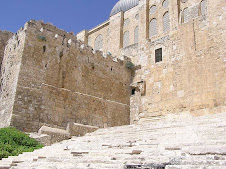
Then we went on to the archaeological site under the walls of the Temple Mount. Right under the Al-Aqsa Mosque we sat on the steps that led up the Hulda Gate. Hulda we were told could be the Hebrew word for 'rats' or it could refer to the wonderful prophet, a woman, who held Josiah to account and was responsible for an earlier re-furbishment of the temple initiated by Josiah. One of my heroes of the Old Testament story!
This was one of the first moments I was really moved by 'place'. These were the very steps that led up to the entrance to the temple - the ones that Jesus would have walked up. This was really where Jesus had been.
We went round the corner and we saw where the market traders would have been. We went down to a pool of purification. We stood under the great high tower where each sabbath a trumpter announced the start of the sabbath - maybe figuring in Jesus's temptations! Then we went down to a lecture room and Hannah took us around a computer simulation of the Temple. Wonderful!!!
A wonderful experience.
Then many set off for more adventures in Jerusalem, including a walk through the tunnels. I set off for Tantur, a lovely lunch and then my first real adventure.
On my own I set off through the checkpoint and into Bethelehem. I negotiated my exciting taxi ride and ended up in Manger Square. With the five shekels change in my pocket and the taxi disappearing into the traffic I arrived at the Bad News of the Day!
In my excitement at getting a good price for the taxi ride I had left my hat [vital in the sun!] behind in the taxi. It cost considerably more than the five shekels!!
No matter, I soon met my two friends We had tea in the Casa Nostra hotel opposite the church of the Nativity.
It was fascinating to go in another taxi through Bethlehem to visit a Refugee camp.
To hear the story of a family at first hand was moving. In 1948 the parents lived in a small village near what is now Tel Aviv, Bet Shemish. As Israeli soldiers moved in, they were moved out of their village into a refugee camp called Deheisheh in Bethlehem. For two years they lived in tents. Then they were given concrete blocks to build a one storey house. Since then the family has remained. Now the five members of the family live in a top floor flat, while other members of the family live lower down.
I was given a wonderful welcome with first arabic tea and then arabic coffee. Delicious.
The hurt and pain of the family was plain to see. He had married his wife nearly twenty years ago. She too had parents who lived in a village in the north in 1948 and had been placed in the Refugee camp.
I was taken to the roof. He showed me six tanks for water and more. Explaining that Israel shuts off the water sometimes for as long as month. It was painful to see. I took a photo of him. I am amazed how close it is to Jerusalem. There was Jerusalem over his shoulder. No further than Bishops Cleeve to Cheltenham [at least to the outskirts of Jerusalem].
He explained that he has not visited Jerusalem for more than ten years. He cannot. Israeli citizens have not been allowed to visit the West bank for a similar period. He acknowledged that there are many Israelis who think positively and support a two state solution to the Holy Land as he would do. But he has not seen a 'nice' Israeli for ten years. He is not allowed to. The only ones he has seen are the soldiers who come into the narrow alleys of his camp from time to time.
12,500 people living in 550 houses in half a kilometre square.
This was disturbing. Very disturbing.
He and his brother in law took me to the check point and then had to return.
I said good bye. They could come no further. This was very, very disturbing.
I returned in time for supper.
Our evening speaker was Alex Awaad, Dean of the Bethlehem Bible School. This is somewhere supported by Rachel Jacques who had given me a recent newsletter and asked me to see if i could make contact. I passed on greetings after the talk.
He proceeded to tell us his mother's story.
It could have been Yousuf's family story.
It covered the same period. It told a similar tale.
It even included a photo of the Dehesheh Refugee camp shortly after it had been set up. It was impassioned.
It gave a theological underpinning of the kind of view of location and place and its UNIMPORTANCE to Christians that I had been reflecting on.
He told the story of land acquisition by Israeli Government. Yes, a security border may be needed. But the wall has been instrumental in taking land from the Palestinians.
His story echoed the story told by Elias Chacour in Blood Brothers. Like Chacour Awaad spoke of the way his parents had taught him forgiveness. Don't look back, look only to the future they had said.
His story was designed to help us feel the anger of the Palestinians and to seek an understanding of their desire to retain and defend their land.
He sought to give us understanding, not to justify violence. Indeed, he spoke of his indebtedness to the Quakers and the Mennonites in his being a pacifist.
Pastor of a Baptist Church in East Jerusalem, he made my mind up. It is to his church that I will go on Sunday.
But before we get to Sunday, we have an interesting Saturday in store.
Lest I forget. My story of Bad News and Good News did have a happy ending. Joanne had a spare sun hat completed with label she had not used. As she was returning to Britain tomorrow she let me have it. I hope the fashion she chose when she bought it suits me.
She showed me the Bethlehem Passport she had been presented as a high bonour by the Open Bethlehem movement on Tuesday. It was great to hear her story ... and begin conversations about the possibility of leading a group from Highbury.
As I said before I came, watch this space!
The day had begun with communion at 6-45 and an early breakfast. We were on the bus and departing through the gates of Tantur at 8-00. Once again we were in the company of Hannah, our Jewish Israeli guide who was going to take us around the Jewish Quarter of Old Jerusalem and to visit the archeological park under the Temple Mount.
Getting off the coach we were taken first to David's Tomb. Nowhere near the city of David's time, a building dating back only a third of the three thousand years back to David but nonetheless revered as the site of David's Tomb.
The building encapsulated the coming together of the three great Abrahamic faiths in the Holy Land. On the ground floor we went into what is now effectively a Synagogue, a place where at the supposed site of David's tomb men and women (separately) will recite psalms. I read Psalms 121 122 and 123 - it was moving to do so.
From there we went upstairs to the upper room. And there we were in the room that has been set aside as the place Christians visit as 'the upper room'. It was upstairs. It was a room. And it reached back half way towards the time of Christ. Then it was that our Guide said a thing that I found helpful.
She explained that with so many of these sites the precise location is clearly not known. But you do know that the place was somewhere round here. It's not so much the location, she said, as what you feel in here. As she said that she tapped her heart.
That's it, exactly. She had gone to the point. The places have left me cold. More than that I am uneasy about the very thought of a 'holy place' in a 'holy land' for a Christian following the Jesus who suggested that Temple, the place where God's presence located is in himself, subsequently in all who hear his words and act on them, for as Paul said each one of us as a follower of Jesus is a 'temple' of the Holy Spirit. In the New jerusalem there will be no temple.
And yet! And yet! It is strangely moving to think of David in that ground floor synagogue and to read from the Psalms. It is strangely moving to stand in that upper room and think of the last supper, looking at a remarkable sculpture placed there by Pope john Paul II on his visit of a tree with three branches (the three faiths), with a branch of olive leaves (for peace) and beside it the fruit of the vine (grapes) and wheat (for bread). A wonderful sculpture.
Wonderful because the room had become a mosque and had all the furnishings of a mosque with towering over that upstairs room a minaret.
Three branches coming from the root of Abraham.
From there we walked through the Jewish Quarter.
Straightaway it felt different from the walk we had done through the Muslim and Christian quarters. It was so much more recent, wider alleys, much cleaner, much richer. The area had been destroyed in the 1967 war ... and so it had all been rebuilt.
The main market street followed the line of the main market street, the Corda, from Roman times. [NB I may be getting some of these names wrong - I will correct them later!!]
We emerged from the Jewish quarter overlooking the Temple Mount and the Dome of the Rock. We stood by the Menorah we had seen on our first walking tour of the city. This time Hannah explained it was made of gold in such a way that it could be placed in a re-built temple.
An ominous note.
We then went through the security checkpost to the Western wall. It used to be called the wailing wall. But now Jews are back in israel and in Jerusalem we were told it is now called the Western wall. That is because it is the closest point on the wall of the Herodion plaza where the Temple once stood, that you can get to the Holiest of Holies, where God's presence was said to dwell. It is not actually the wall of the temple. It is the wall of the box which herod built in order to accommodate his re-furbished temple. it was moving to join the men, mostly clearly jews and orthodox too, and to spend a moment in prayer at the western wall. I found myself reciting the Lord's prayer. Why, I'm not sure. But it seemed strangely right.
On the way to our meeting point we passed some Ethiopian Jews who were marking the
presentation to their 6 year old children at a Religious school of their first prayer book at the Western wall. Hannah explained that they were among those Jewish people airlifted out of Ethiopia by Israel in the 80's and 90's in response to the famine. They claimed to trace their ancestry as Jews back to the exile. The story of the Falasha Jews is a fascinating one.
Then we went on to the archaeological site under the walls of the Temple Mount. Right under the Al-Aqsa Mosque we sat on the steps that led up the Hulda Gate. Hulda we were told could be the Hebrew word for 'rats' or it could refer to the wonderful prophet, a woman, who held Josiah to account and was responsible for an earlier re-furbishment of the temple initiated by Josiah. One of my heroes of the Old Testament story!
This was one of the first moments I was really moved by 'place'. These were the very steps that led up to the entrance to the temple - the ones that Jesus would have walked up. This was really where Jesus had been.
We went round the corner and we saw where the market traders would have been. We went down to a pool of purification. We stood under the great high tower where each sabbath a trumpter announced the start of the sabbath - maybe figuring in Jesus's temptations! Then we went down to a lecture room and Hannah took us around a computer simulation of the Temple. Wonderful!!!
A wonderful experience.
Then many set off for more adventures in Jerusalem, including a walk through the tunnels. I set off for Tantur, a lovely lunch and then my first real adventure.
On my own I set off through the checkpoint and into Bethelehem. I negotiated my exciting taxi ride and ended up in Manger Square. With the five shekels change in my pocket and the taxi disappearing into the traffic I arrived at the Bad News of the Day!
In my excitement at getting a good price for the taxi ride I had left my hat [vital in the sun!] behind in the taxi. It cost considerably more than the five shekels!!
No matter, I soon met my two friends We had tea in the Casa Nostra hotel opposite the church of the Nativity.
It was fascinating to go in another taxi through Bethlehem to visit a Refugee camp.
To hear the story of a family at first hand was moving. In 1948 the parents lived in a small village near what is now Tel Aviv, Bet Shemish. As Israeli soldiers moved in, they were moved out of their village into a refugee camp called Deheisheh in Bethlehem. For two years they lived in tents. Then they were given concrete blocks to build a one storey house. Since then the family has remained. Now the five members of the family live in a top floor flat, while other members of the family live lower down.
I was given a wonderful welcome with first arabic tea and then arabic coffee. Delicious.
The hurt and pain of the family was plain to see. He had married his wife nearly twenty years ago. She too had parents who lived in a village in the north in 1948 and had been placed in the Refugee camp.
I was taken to the roof. He showed me six tanks for water and more. Explaining that Israel shuts off the water sometimes for as long as month. It was painful to see. I took a photo of him. I am amazed how close it is to Jerusalem. There was Jerusalem over his shoulder. No further than Bishops Cleeve to Cheltenham [at least to the outskirts of Jerusalem].
He explained that he has not visited Jerusalem for more than ten years. He cannot. Israeli citizens have not been allowed to visit the West bank for a similar period. He acknowledged that there are many Israelis who think positively and support a two state solution to the Holy Land as he would do. But he has not seen a 'nice' Israeli for ten years. He is not allowed to. The only ones he has seen are the soldiers who come into the narrow alleys of his camp from time to time.
12,500 people living in 550 houses in half a kilometre square.
This was disturbing. Very disturbing.
He and his brother in law took me to the check point and then had to return.
I said good bye. They could come no further. This was very, very disturbing.
I returned in time for supper.
Our evening speaker was Alex Awaad, Dean of the Bethlehem Bible School. This is somewhere supported by Rachel Jacques who had given me a recent newsletter and asked me to see if i could make contact. I passed on greetings after the talk.
He proceeded to tell us his mother's story.
It could have been Yousuf's family story.
It covered the same period. It told a similar tale.
It even included a photo of the Dehesheh Refugee camp shortly after it had been set up. It was impassioned.
It gave a theological underpinning of the kind of view of location and place and its UNIMPORTANCE to Christians that I had been reflecting on.
He told the story of land acquisition by Israeli Government. Yes, a security border may be needed. But the wall has been instrumental in taking land from the Palestinians.
His story echoed the story told by Elias Chacour in Blood Brothers. Like Chacour Awaad spoke of the way his parents had taught him forgiveness. Don't look back, look only to the future they had said.
His story was designed to help us feel the anger of the Palestinians and to seek an understanding of their desire to retain and defend their land.
He sought to give us understanding, not to justify violence. Indeed, he spoke of his indebtedness to the Quakers and the Mennonites in his being a pacifist.
Pastor of a Baptist Church in East Jerusalem, he made my mind up. It is to his church that I will go on Sunday.
But before we get to Sunday, we have an interesting Saturday in store.
Lest I forget. My story of Bad News and Good News did have a happy ending. Joanne had a spare sun hat completed with label she had not used. As she was returning to Britain tomorrow she let me have it. I hope the fashion she chose when she bought it suits me.
She showed me the Bethlehem Passport she had been presented as a high bonour by the Open Bethlehem movement on Tuesday. It was great to hear her story ... and begin conversations about the possibility of leading a group from Highbury.
As I said before I came, watch this space!
Thursday, April 3, 2008
Into Bethlehem
'Tantur' simply means 'Hill Top'. From our meeting room we look down at the checkpoint and the wall that separates Bethlehem from Jerusalem, and over the wall to Bethlehem.
This morning we set off by coach through the checkpoint and through Bethlehem into the West Bank. Driving along a road designated for Jewish settlers in the west bank we went up to the 'Herodion', the summer palace built by Herod. In a commanding position at the hill top palace had commanding views over the Judaean wilderness to the Dead Sea, glinting in the distance.
Beyond were the hazy Moabite hills.
There was something imposing, powerful and disturbing about the palace. It was a statement of power. Built by the Herod who had re-built the second temple and had been responsible for the slaying of the innocents, it had been the base for the Bar Kochba revolt in the second century AD.
Just below the palace was an Israeli army outpost, and beyond two settlements.
We returned to Bethelehem and the Shepherds fields. The site of a monastery going back to the very beginnings of the monastic movement in the 4th century, it was moving to sit in the kind of cave that might have been used by shepherds looking after their sheep and read the account of the shepherds from Luke 2 and then to sing Silent night.
From the Shepherds fields we made our way to Manger Square and the church of the nativity. Again, I had major problems with 'location'. Does it really matter? Michael McGarry suggested that as Hadrian had located a temple on the spot Helen, iConstantine's mother, later identified as the place of the nativity it was quite likely.
I did not go down into the grotto, but instead went into a neighbouring church and another cave. It was quite moving. It was associated with Jerome's translation of the Bible. The white clad walls, and the limestone rock with all its layers, made caves exactly what you would expect. They were the kind of caves that could easily have been used in the way the bible describes. Strange and yet strangely moving.
After Manger Square we made our way through the busy, narrow alleys, up the hill to the Lutheran centre, a wonderful new building with a very impressive design that was host to a Lutheran church community serving the communtiy in Bethlehem.
The Rev Dr Dimitri Rahab, a Palestinian Lutheran Pastor, spoke to us of his vision for church work in Bethelehm. He felt very much called to a ministry of preaching the good news that so needs to be heard, of teaching and of healing. He spoke of the very significant work of social service that church is carrying out. He made five observations:
1) This is a very biblical time and place ... as in the time of Jeremiah too many people talk the language of peace without living a life of peace. There is a call, he suggested, to work for peace with justice.
2) There's too much politics - instead of working 'up there' in the higher echelons of 'politics' it was more important to work on the ground, caring for the society and making a difference there.
3) There's too much religion - and a need for more sprituality and prayer.
4) There's too much humanitarian aid - and not enough work aimed at development
5) There's too much 'pess-optimism'. Optimistic one day. Pessimistic the next. There should instead be hope that takes seriously the present situation, where Dimitri Rahab saw little change for two generations, and at the same time works for the good that will come in the future. Hope sees what's going on and still plants olive trees.
Our session came to an end and we left for lunch, while a group of German parliamentarians followed us to be addressed by the same Pastor. It is wonderful to see the way inwhich we are treated to such high powered speakers.
Lunch over, we walked through the streets of Bethlehem to the Wiam centre for reconciliation and an equally inspiring address by Zoughbi Zoughbi, who last year came over to Britain with the Fellowship of Reconciliation on a speaking tour.
He spoke of the need for the work of reconciliation to be done at the local level, bringing healing where rifts were caused often as a result of the conflict. Again, most moving.
Walking back towards Tantur instead of taking the bus, we headed for Rachel's tomb only to find it's inaccessible from Bethlehem and the other side of the wall. A visit to a Palestinian exhibition centre included an unexpected meeting with a family whose story I will tell later.
The walk back took us through the check point on foot. A menacing experience and that was just for us.
AFter prayers and our evening meal we had another high powered lecture this time from Deborah Wiseman, an Orthodox Jew. She refused the epithet moderate and spoke of her passion for her religion, but eqully of her commitment to a tolerance that was tolerant of the other, a pluralism that could see other people believed differently, and an openness that was prepared to learn from others. AFter the two earlier speakers of the day we were offered another view of the very same barrier: this time while opposing the occupation of the West Bank and the settlements, Debborah Wiseman advocated a state for Israel and a state for the Palestinians but could see the value of the security wall. She spoke of her passionate commitment to human rights and to change.
Another moving and troubling day came to an end, with answers to questions as elusive as ever. But at the same time a very real sense of the vital importance of coming alongside people, seeking understanding and seeking to make a difference.
This morning we set off by coach through the checkpoint and through Bethlehem into the West Bank. Driving along a road designated for Jewish settlers in the west bank we went up to the 'Herodion', the summer palace built by Herod. In a commanding position at the hill top palace had commanding views over the Judaean wilderness to the Dead Sea, glinting in the distance.
Beyond were the hazy Moabite hills.
There was something imposing, powerful and disturbing about the palace. It was a statement of power. Built by the Herod who had re-built the second temple and had been responsible for the slaying of the innocents, it had been the base for the Bar Kochba revolt in the second century AD.
Just below the palace was an Israeli army outpost, and beyond two settlements.
We returned to Bethelehem and the Shepherds fields. The site of a monastery going back to the very beginnings of the monastic movement in the 4th century, it was moving to sit in the kind of cave that might have been used by shepherds looking after their sheep and read the account of the shepherds from Luke 2 and then to sing Silent night.
From the Shepherds fields we made our way to Manger Square and the church of the nativity. Again, I had major problems with 'location'. Does it really matter? Michael McGarry suggested that as Hadrian had located a temple on the spot Helen, iConstantine's mother, later identified as the place of the nativity it was quite likely.
I did not go down into the grotto, but instead went into a neighbouring church and another cave. It was quite moving. It was associated with Jerome's translation of the Bible. The white clad walls, and the limestone rock with all its layers, made caves exactly what you would expect. They were the kind of caves that could easily have been used in the way the bible describes. Strange and yet strangely moving.
After Manger Square we made our way through the busy, narrow alleys, up the hill to the Lutheran centre, a wonderful new building with a very impressive design that was host to a Lutheran church community serving the communtiy in Bethlehem.
The Rev Dr Dimitri Rahab, a Palestinian Lutheran Pastor, spoke to us of his vision for church work in Bethelehm. He felt very much called to a ministry of preaching the good news that so needs to be heard, of teaching and of healing. He spoke of the very significant work of social service that church is carrying out. He made five observations:
1) This is a very biblical time and place ... as in the time of Jeremiah too many people talk the language of peace without living a life of peace. There is a call, he suggested, to work for peace with justice.
2) There's too much politics - instead of working 'up there' in the higher echelons of 'politics' it was more important to work on the ground, caring for the society and making a difference there.
3) There's too much religion - and a need for more sprituality and prayer.
4) There's too much humanitarian aid - and not enough work aimed at development
5) There's too much 'pess-optimism'. Optimistic one day. Pessimistic the next. There should instead be hope that takes seriously the present situation, where Dimitri Rahab saw little change for two generations, and at the same time works for the good that will come in the future. Hope sees what's going on and still plants olive trees.
Our session came to an end and we left for lunch, while a group of German parliamentarians followed us to be addressed by the same Pastor. It is wonderful to see the way inwhich we are treated to such high powered speakers.
Lunch over, we walked through the streets of Bethlehem to the Wiam centre for reconciliation and an equally inspiring address by Zoughbi Zoughbi, who last year came over to Britain with the Fellowship of Reconciliation on a speaking tour.
He spoke of the need for the work of reconciliation to be done at the local level, bringing healing where rifts were caused often as a result of the conflict. Again, most moving.
Walking back towards Tantur instead of taking the bus, we headed for Rachel's tomb only to find it's inaccessible from Bethlehem and the other side of the wall. A visit to a Palestinian exhibition centre included an unexpected meeting with a family whose story I will tell later.
The walk back took us through the check point on foot. A menacing experience and that was just for us.
AFter prayers and our evening meal we had another high powered lecture this time from Deborah Wiseman, an Orthodox Jew. She refused the epithet moderate and spoke of her passion for her religion, but eqully of her commitment to a tolerance that was tolerant of the other, a pluralism that could see other people believed differently, and an openness that was prepared to learn from others. AFter the two earlier speakers of the day we were offered another view of the very same barrier: this time while opposing the occupation of the West Bank and the settlements, Debborah Wiseman advocated a state for Israel and a state for the Palestinians but could see the value of the security wall. She spoke of her passionate commitment to human rights and to change.
Another moving and troubling day came to an end, with answers to questions as elusive as ever. But at the same time a very real sense of the vital importance of coming alongside people, seeking understanding and seeking to make a difference.
Wednesday, April 2, 2008
Seeing things as others see them
Day 2 of our our journey of reconciliation began with a 6-30 Mass followed by prayers at 7-00. Not the usual way I start the day.
Our coach left Tantur promptly at 8-00 to take us to the old city of Jerusalem in the company of Alan Rabinowitz, a Jewish guide who had been living in Jerusalem for 20 years.
We entered the old city through the Dung Gate with the intention of going on to visit the Dome of the Rock on what Jews and Christians regard as the Temple Mount. The queues meant that tourists are back in Jerusalem, Israel and the West Bank. They also meant we would not be able to visit as we intended.
Instead we took a look at the mount from a wonderful vantage point and began a fascinating walk through the crowded, narrow alleyways of the ancient city.
We visited first the Muslim Quarter to be reminded of the centuries of Muslim presence in this ancient city. As we moved fromthe Muslim to the Christian quarter we went up on to the flat roof of an Austrian hospice to have a remarkable rooftop view of the whole of the ancient city.
It was then along part of the Via Dolorosa to the Church of the Sepulchre. Mixed feelings here. Strange to think there was some reason for thinking this was the site of the Crufixion, the burial and the resurrection of Jesus. In some ways it was moving. In other ways it was forbidding, if that's the right word! I wondered whether the concentration of the importance of 'place' was a denial of all that Christ had stood for. Isn't the risen Christ let loose in the world and not identified with a 'holy place'? Much food for thought!
Our walk took us through the Christian Quarter and on to the Armenian Quarter.
It was back for lunch and a 90 minute break before a two hour session with a remarkable Rabbi David Rosen. Once Chief Rabbi in South Africa, in Ireland and now very involved in bringing together leaders of the three great Abrahamic religions in conversations with each other. This the first time such conversations have taken place at a formal level in history.
It was remarkable to hear of his commitment to his own faith, and at the same time a commitment to working for peace and reconciliation among those of other faiths. Not only food for thought, but grounds for hope.
After supper the final session of the day was a talk by Mohammad Haroun who has given a lifetime of commitment again as an Islam to an understanding of Islam that rejects what might be called Islamism with its agenda of world domination, in favour of the need to see in others people created in the image of God.
The most moving moment of our journey of reconciliation came when one of our number, a vicar in Belfast, Northern Ireland insisted on getting in one more question after the alotted time. Drawing on her experience of peacemakers in Northern Ireland experiencing the rejection of their contemporaries and sometimes of their communities, she thanked our speaker and urged him to continue in his commitment to work for peace for the good of his chidlren and his grandchildren too.
A remarkable day that seemed to give rise to hope.
Our journey continues tomorrow at an even earlier hour ... so more news later!
Our coach left Tantur promptly at 8-00 to take us to the old city of Jerusalem in the company of Alan Rabinowitz, a Jewish guide who had been living in Jerusalem for 20 years.
We entered the old city through the Dung Gate with the intention of going on to visit the Dome of the Rock on what Jews and Christians regard as the Temple Mount. The queues meant that tourists are back in Jerusalem, Israel and the West Bank. They also meant we would not be able to visit as we intended.
Instead we took a look at the mount from a wonderful vantage point and began a fascinating walk through the crowded, narrow alleyways of the ancient city.
We visited first the Muslim Quarter to be reminded of the centuries of Muslim presence in this ancient city. As we moved fromthe Muslim to the Christian quarter we went up on to the flat roof of an Austrian hospice to have a remarkable rooftop view of the whole of the ancient city.
It was then along part of the Via Dolorosa to the Church of the Sepulchre. Mixed feelings here. Strange to think there was some reason for thinking this was the site of the Crufixion, the burial and the resurrection of Jesus. In some ways it was moving. In other ways it was forbidding, if that's the right word! I wondered whether the concentration of the importance of 'place' was a denial of all that Christ had stood for. Isn't the risen Christ let loose in the world and not identified with a 'holy place'? Much food for thought!
Our walk took us through the Christian Quarter and on to the Armenian Quarter.
It was back for lunch and a 90 minute break before a two hour session with a remarkable Rabbi David Rosen. Once Chief Rabbi in South Africa, in Ireland and now very involved in bringing together leaders of the three great Abrahamic religions in conversations with each other. This the first time such conversations have taken place at a formal level in history.
It was remarkable to hear of his commitment to his own faith, and at the same time a commitment to working for peace and reconciliation among those of other faiths. Not only food for thought, but grounds for hope.
After supper the final session of the day was a talk by Mohammad Haroun who has given a lifetime of commitment again as an Islam to an understanding of Islam that rejects what might be called Islamism with its agenda of world domination, in favour of the need to see in others people created in the image of God.
The most moving moment of our journey of reconciliation came when one of our number, a vicar in Belfast, Northern Ireland insisted on getting in one more question after the alotted time. Drawing on her experience of peacemakers in Northern Ireland experiencing the rejection of their contemporaries and sometimes of their communities, she thanked our speaker and urged him to continue in his commitment to work for peace for the good of his chidlren and his grandchildren too.
A remarkable day that seemed to give rise to hope.
Our journey continues tomorrow at an even earlier hour ... so more news later!
Tuesday, April 1, 2008
Our Journey of Reconciliaion begins
After a good journey we arrived at Ben Gurion Airport at 10-20 on Monday evening. A 45 minute coach journey took us up the 2,600 feet to Jerusalem. As we turned into the Tantur Institute we saw a road sign that was so memorable. To the left the city centre; to the right Bet lehem - two words, hebrew letters, the house of bread. Bethlehem!
We had arrived!
It wasn't much before 1-00 before we got to bed and we were up at 7-00 ready for breakfast and an introduction to Tantur.
The inspiration of those who had caught the vision for ecumenism at the Vatican Council, it is a one time Knights of Malta hospital, one time British Prisoner of War camp, one time Roman Catholic Seminary. It is now an Institute where Christians of all denominations come together to study and to experience the Holy Land. On land owned by the Vatican, it is an Institute 'owned' by all denominations bringing Christians together, and bringing Christians together with Jews and Muslims.
We heard of its work behind the scenes in bringing people together from opposing sides of a very tense situation in conversations for peace. Michael McGarry, the current Rector of Tantur shared his vision for that work of peace-making and the excitement of all that Tantur does. Michael Roberts, one time Principal of Westcott house, a theological college in Cambridge, expressed his hope and the hope of the Tantur trustees that our stay should be very much a Journey of Reconciliation.
Michael McGarry took us on to the roof of the Institute. We looked down over the olive groves to the check point into Bethlehem, and to the wall separating Bethlehem from Jerusalem and over into the town of Bethlehem. It was a deeply moving, and profoundly disturbing moment.
The morning's introduction over, it was good to share with Michael McGarry as he said mass. Though not able to take the elements with those who were Catholics there was a very real sense of oneness in all that we shared together. The reading was from John 3: Jesus' conversation with Nicodemus where he speaks of the wind blowing where it will. Michael McGarry suggested that the church and indeed we as individual Christians are like a sailing boat. The church ... and indeed we as individual Christians really only come into our own when the wind catches our sails.
Our prayer for this week is that the wind catches our sails and inspires us for our return.
A delightful lunch over, we went straight out to a waiting bus where we were joined by Hannah, an Israeli Jew who works for the Council of Christians and Jews in jerusalem, based here at Tantur. She was to be our guide in an orientation tour of Jerusalem.
It took us past new settlements to our first view of Jerusalem in all its splendour. The Temple Mount and the Dome of the Rock lay on the opposite side of the valley. To our right, Bethlehem, its wall streaking as far as the eye can see. At 20 feet high an imposing and disturbing sight. Hannah sees her job as enabling people to see Jerusalem through the eyes of other people. Among those she acts as Guide for are Israeli soldiers. She recalls a conversation two had in which one asked why the wall had not been clad with limestone cladding as so many of the builidngs in Jerusalem had been (a legacy of the years of British mandate rule). The other replied that the wall was only to be a temporary message. Hannah expressed her hope that should be so.
From there we drive round to a remarkable view of the Judaean Wilderness. Jerusalem is a city on a mountain: at 2,600 feet it is a very high city. It's where the rain is caught coming as it predominantly does from the West. Climb to this highest point in the city and you look down at a wilderness, a desert that stretches down and down and down past Jericho towards the Dead Sea.
There in the distance a settlement: should that be linked by a fenced off road to Jerusalem it would effectively cut off the north and south parts of that part of the west bank. Controversy rages.
We came back round past the small Arab settlement that was in Jesus' day Bethany. And then we came over the Mount of Olives, the entrance to the city in Jesus' day and saw the view he would have seen when he arrived in the city and wept over it. 'Would that you had seen the things that make for peace,' he said then. We could echo those words today too.
There we could see the Kidron valley and the wall of the city, the Golden Gate through which he may well have come, and the temple mount - the platform built by Herod in the rebuilding of the second temple, and at its centre the Dome of the Rock. To the left the Al Aqba mosque.
Down to the right the Garden of Gethsemane and there beyond the further city wall, the church of the holy sepulcrhe. Was that the place Jesus was buried or was it in the garden tomb, further away still. Who knows? But that's not the point. Seeing the city. Being there. Being here, all those familiar stories have a remarkable ring of truth.
On from the Mount of Olives and around the ancient city our itinerary then took us to the modern city of Jerusalem and to the Knesset, the Israeli parliament and seat of government. We were shown the three dimensions of this democratic state: parliament, the legislature, the executive with its finance ministry and the judiciary with the courts.
Hannah pointed out how the courts were on a hill that was higher than the knesset. Parliament may make the law but they are also under the law.
She went on to comment on the way in which Jerusalem is built around four hills. There's the Temple Mount where God's presence was located; over to the right the Mount of Olives where the shekinah departed at the destruction of the temple at the Exile waiting there for three and a half years in the hope of the return of the Israelites. When they did not return that's where the shekinah, the glory of God, ascended to heaven. It was from the Mount of Olives that the Messiah would come. It was from the Mount of Olives that Jesus came. And it was there that he too ascended to his father in heaven. The Mount of Olives, therefore, links heaven and earth.
Then there was the mount where the seat of government was in all its branches. And beyond those buildings another mount. Here was the memorial to the holocaust, cemeteries to fallen soldiers. A reminder of the deep memory and the cause of the creation of the unique state of Israel where Jewishness is the one criterion for citizenship.
Our tour over we returned to Tantur for evening prayers, another lovely meal and then a conversation with Father Tom Skranski. A key player in Vatican II, he had been involved with Tantur since its inception and for a while succeeded a Quaker as Rector of the Institute. He spoke of the call to reconciliation and the supreme importance of reconciliation in the life and ministry of the chruch and of each of us as Christians. What was the first question in teh Bible, he asked. Where are you? God's question to humanity, to each one of us in Genesis 3. What was the second question? He also asked. Where is your brother? God's question to Cain of his brother Abel.
The first question each of us must ask on our journey of faith as we respond to God and seek to Love God. The second question is equally important for each of us as Christians as we see to answer it in a way very different from Cain's dismissive response.
After hearing the story of Brendan Duddy, the pacifist in Northern Ireland who had been instrumental in bringing the Government and the IRA together throughout the period of the troubles when the Government had vowed never to speak to terrorists, to hear Father Tom speaking of the way in which Tantur too seeks to bring people together who would not otherwise speak to one another. In that process of conversation in which people meet face to face and hear the heart beat of the other lies hope for the beginnings of reconciliation.
It was doubly moving to hear his hope against hope sitting where I was. I was facing the windows and looking through them on to the check point into Bethlehem and beyond to the flood lit wall. Would that that soldier is right and that it is temporary. That has to be our hope and prayer.
Tomorow we head off into the old city of Jerusalem on the next stage of our journey of reconciliation.
We had arrived!
It wasn't much before 1-00 before we got to bed and we were up at 7-00 ready for breakfast and an introduction to Tantur.
The inspiration of those who had caught the vision for ecumenism at the Vatican Council, it is a one time Knights of Malta hospital, one time British Prisoner of War camp, one time Roman Catholic Seminary. It is now an Institute where Christians of all denominations come together to study and to experience the Holy Land. On land owned by the Vatican, it is an Institute 'owned' by all denominations bringing Christians together, and bringing Christians together with Jews and Muslims.
We heard of its work behind the scenes in bringing people together from opposing sides of a very tense situation in conversations for peace. Michael McGarry, the current Rector of Tantur shared his vision for that work of peace-making and the excitement of all that Tantur does. Michael Roberts, one time Principal of Westcott house, a theological college in Cambridge, expressed his hope and the hope of the Tantur trustees that our stay should be very much a Journey of Reconciliation.
Michael McGarry took us on to the roof of the Institute. We looked down over the olive groves to the check point into Bethlehem, and to the wall separating Bethlehem from Jerusalem and over into the town of Bethlehem. It was a deeply moving, and profoundly disturbing moment.
The morning's introduction over, it was good to share with Michael McGarry as he said mass. Though not able to take the elements with those who were Catholics there was a very real sense of oneness in all that we shared together. The reading was from John 3: Jesus' conversation with Nicodemus where he speaks of the wind blowing where it will. Michael McGarry suggested that the church and indeed we as individual Christians are like a sailing boat. The church ... and indeed we as individual Christians really only come into our own when the wind catches our sails.
Our prayer for this week is that the wind catches our sails and inspires us for our return.
A delightful lunch over, we went straight out to a waiting bus where we were joined by Hannah, an Israeli Jew who works for the Council of Christians and Jews in jerusalem, based here at Tantur. She was to be our guide in an orientation tour of Jerusalem.
It took us past new settlements to our first view of Jerusalem in all its splendour. The Temple Mount and the Dome of the Rock lay on the opposite side of the valley. To our right, Bethlehem, its wall streaking as far as the eye can see. At 20 feet high an imposing and disturbing sight. Hannah sees her job as enabling people to see Jerusalem through the eyes of other people. Among those she acts as Guide for are Israeli soldiers. She recalls a conversation two had in which one asked why the wall had not been clad with limestone cladding as so many of the builidngs in Jerusalem had been (a legacy of the years of British mandate rule). The other replied that the wall was only to be a temporary message. Hannah expressed her hope that should be so.
From there we drive round to a remarkable view of the Judaean Wilderness. Jerusalem is a city on a mountain: at 2,600 feet it is a very high city. It's where the rain is caught coming as it predominantly does from the West. Climb to this highest point in the city and you look down at a wilderness, a desert that stretches down and down and down past Jericho towards the Dead Sea.
There in the distance a settlement: should that be linked by a fenced off road to Jerusalem it would effectively cut off the north and south parts of that part of the west bank. Controversy rages.
We came back round past the small Arab settlement that was in Jesus' day Bethany. And then we came over the Mount of Olives, the entrance to the city in Jesus' day and saw the view he would have seen when he arrived in the city and wept over it. 'Would that you had seen the things that make for peace,' he said then. We could echo those words today too.
There we could see the Kidron valley and the wall of the city, the Golden Gate through which he may well have come, and the temple mount - the platform built by Herod in the rebuilding of the second temple, and at its centre the Dome of the Rock. To the left the Al Aqba mosque.
Down to the right the Garden of Gethsemane and there beyond the further city wall, the church of the holy sepulcrhe. Was that the place Jesus was buried or was it in the garden tomb, further away still. Who knows? But that's not the point. Seeing the city. Being there. Being here, all those familiar stories have a remarkable ring of truth.
On from the Mount of Olives and around the ancient city our itinerary then took us to the modern city of Jerusalem and to the Knesset, the Israeli parliament and seat of government. We were shown the three dimensions of this democratic state: parliament, the legislature, the executive with its finance ministry and the judiciary with the courts.
Hannah pointed out how the courts were on a hill that was higher than the knesset. Parliament may make the law but they are also under the law.
She went on to comment on the way in which Jerusalem is built around four hills. There's the Temple Mount where God's presence was located; over to the right the Mount of Olives where the shekinah departed at the destruction of the temple at the Exile waiting there for three and a half years in the hope of the return of the Israelites. When they did not return that's where the shekinah, the glory of God, ascended to heaven. It was from the Mount of Olives that the Messiah would come. It was from the Mount of Olives that Jesus came. And it was there that he too ascended to his father in heaven. The Mount of Olives, therefore, links heaven and earth.
Then there was the mount where the seat of government was in all its branches. And beyond those buildings another mount. Here was the memorial to the holocaust, cemeteries to fallen soldiers. A reminder of the deep memory and the cause of the creation of the unique state of Israel where Jewishness is the one criterion for citizenship.
Our tour over we returned to Tantur for evening prayers, another lovely meal and then a conversation with Father Tom Skranski. A key player in Vatican II, he had been involved with Tantur since its inception and for a while succeeded a Quaker as Rector of the Institute. He spoke of the call to reconciliation and the supreme importance of reconciliation in the life and ministry of the chruch and of each of us as Christians. What was the first question in teh Bible, he asked. Where are you? God's question to humanity, to each one of us in Genesis 3. What was the second question? He also asked. Where is your brother? God's question to Cain of his brother Abel.
The first question each of us must ask on our journey of faith as we respond to God and seek to Love God. The second question is equally important for each of us as Christians as we see to answer it in a way very different from Cain's dismissive response.
After hearing the story of Brendan Duddy, the pacifist in Northern Ireland who had been instrumental in bringing the Government and the IRA together throughout the period of the troubles when the Government had vowed never to speak to terrorists, to hear Father Tom speaking of the way in which Tantur too seeks to bring people together who would not otherwise speak to one another. In that process of conversation in which people meet face to face and hear the heart beat of the other lies hope for the beginnings of reconciliation.
It was doubly moving to hear his hope against hope sitting where I was. I was facing the windows and looking through them on to the check point into Bethlehem and beyond to the flood lit wall. Would that that soldier is right and that it is temporary. That has to be our hope and prayer.
Tomorow we head off into the old city of Jerusalem on the next stage of our journey of reconciliation.
Subscribe to:
Posts (Atom)

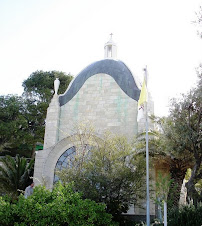%2BChurch.jpg)